
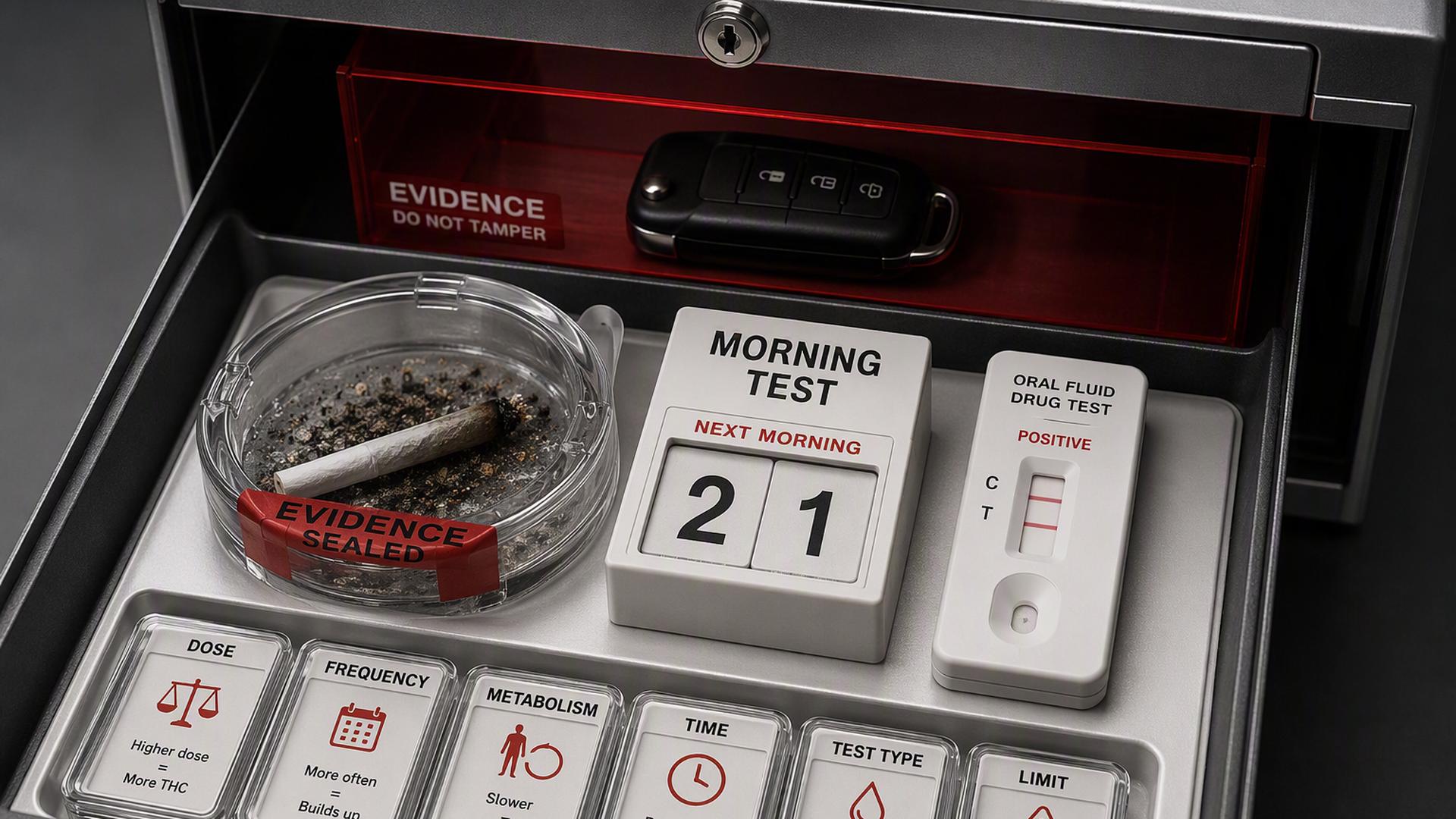
6 Reasons Why You Might Still Fail a Drug Driving Test the Morning After Smoking Weed
Published by Drug Driving Solicitors, specialist UK solicitors defending drivers facing drug driving charges.
Smoking cannabis in the evening and waking up feeling completely normal can create a false sense of certainty about driving the following morning. The noticeable effects may have disappeared after a night's sleep, but that does not necessarily mean the THC concentration in your blood has fallen below the legal driving limit.
In England and Wales, Section 5A of the Road Traffic Act 1988 makes it an offence to drive, attempt to drive or be in charge of a motor vehicle with a specified controlled drug above its prescribed concentration. Importantly, the prosecution does not need to prove that the drug actually affected your driving. GOV.UK confirms that it can be illegal to drive with specified levels of illegal drugs in your blood even if they have not affected your ability to drive.
1. Regular Cannabis Use Can Leave THC Behind for Much Longer
Someone who uses cannabis frequently can have a very different THC profile from somebody who smokes occasionally. This is one of the main reasons why another person's experience of being "fine the next morning" is a poor guide to your own potential blood result.
Frequent Use Can Produce Residual Blood THC
Repeated cannabis use can result in THC remaining measurable for considerably longer periods. A systematic review of frequent cannabis users found that some participants still had blood THC concentrations above 2 ng/mL after six days of abstinence. The researchers concluded that concentrations above 2 ng/mL do not necessarily indicate recent cannabis use among frequent users.
That does not mean every regular user will remain above the England and Wales driving limit for several days. It does show, however, that there is no universal timetable that can accurately predict when a frequent user's concentration will fall below a particular threshold.
Yesterday Evening May Not Tell the Whole Story
For an occasional user, most of the THC present may relate primarily to the most recent occasion of use. For a frequent or heavy user, residual THC associated with earlier consumption can make the concentration pattern more complicated.
Two people could therefore smoke a similar amount at the same time, go to bed at the same hour and produce significantly different blood results the next morning. Frequency of use is an important part of the picture, not simply the number of hours that have passed since the last joint.
2. Edibles and Other Cannabis Products Follow Different Timelines
The word "cannabis" covers products that can enter the body in very different ways. Smoking, vaping, oils, capsules and edible cannabis should not be assumed to produce identical absorption and clearance patterns.
Edibles Usually Peak Later Than Inhaled Cannabis
When cannabis is smoked or vaporised, THC enters the circulation rapidly through the lungs. Oral cannabis must instead pass through the digestive system and undergo extensive first-pass metabolism. Reviews of human research have found oral THC absorption to be highly variable, with peak plasma concentrations generally occurring later than with inhaled cannabis.
A controlled study involving cannabis brownies found that subjective and performance effects generally peaked around 1.5 to 3 hours after consumption and could last for six to eight hours. Whole-blood THC remained detectable for as long as 22 hours in some participants under the study's analytical threshold.
Late-Night Consumption Can Shift the Whole Timeline
If an edible is consumed shortly before bed, it is therefore misleading to assume that its concentration has been falling steadily throughout every hour of sleep. Part of the night may still involve absorption and rising concentrations.
Different doses and formulations add further uncertainty. A cannabis brownie, oil or capsule may not behave in exactly the same way, and research has identified particularly high variability among oral cannabis preparations. That makes simple rules such as "eight hours after cannabis is enough" unreliable.
3. Feeling Sober Does Not Tell You Your Blood THC Concentration
One of the most understandable mistakes is to judge whether it is safe or legal to drive solely by how you feel. Once the obvious high has disappeared, a person may feel rested, alert and entirely capable of driving.
Subjective Effects and Laboratory Measurements Are Different
Feeling intoxicated is a subjective experience. Blood THC concentration is a laboratory measurement. Although the two can be related, they are not interchangeable, particularly when tolerance, route of administration, frequency of use and individual physiology are involved.
Research into cannabis pharmacokinetics has demonstrated that the relationship between cannabinoid concentrations and drug effects can be complex. With oral cannabis, for example, correlations between cannabinoid concentrations and various measures of cognitive performance have not always followed a simple or predictable pattern.
Section 5A Does Not Require Proof That You Felt High
This distinction matters legally because Section 5A is a specified-limit offence. CPS guidance describes it as a strict-liability offence designed to avoid the need for prosecutors to prove impairment.
A driver could therefore be speaking normally, driving without obvious difficulty and genuinely believe that the cannabis effects have finished, yet still have a blood THC concentration above the prescribed limit. How sober you feel cannot tell you whether a laboratory would record you above or below that threshold.
4. THC Does Not Leave the Body in the Same Way as Alcohol
People are accustomed to thinking about drink driving in terms of alcohol gradually being metabolised over time. Applying the same mental model to cannabis can be misleading because THC has markedly different pharmacokinetic characteristics.
THC Is Highly Fat-Soluble
THC is highly lipophilic, meaning it has an affinity for fatty tissues. After entering the circulation, it is rapidly distributed throughout the body, including into adipose tissue. Scientific reviews describe subsequent redistribution from these tissues back into the bloodstream as part of THC's complex elimination pattern.
This helps explain why the disappearance of the initial high does not amount to a simple countdown until THC reaches zero. Concentrations fall rapidly after smoking, but THC distribution, metabolism and redistribution continue after the strongest effects have passed.
There Is No Simple Hour-by-Hour Formula
Alcohol and cannabis therefore should not be treated as though they have interchangeable clearance rules. Even with alcohol, individual variation exists, but THC presents additional complications because of its distribution into tissues, the user's consumption history and the route by which it was taken.
This is also why attempting to work backwards from the time of your final joint and calculate an exact morning blood concentration is unrealistic. Without an evidential laboratory measurement, there is no reliable home calculation that can establish whether your THC level is below the prescribed driving threshold.
5. The Cannabis Limit Is Low and Does Not Require Heavy Impairment
Some drivers assume that the legal threshold is intended to identify only people who are obviously or severely intoxicated. That is not how the specified-limit offence operates.
The Law Uses a Prescribed Concentration
For THC, the prescribed limit in England and Wales is 2 micrograms per litre of blood. Section 5A focuses on whether the concentration of the specified controlled drug is above its statutory limit, rather than requiring the prosecution to demonstrate poor coordination, dangerous driving or visible intoxication. CPS guidance expressly describes Section 5A as avoiding the need to prove impairment.
Cannabis is commonly described as being dealt with under a "zero-tolerance" policy because the threshold is deliberately low. Strictly speaking, however, the CPS states that the offence is not a literal zero-tolerance offence. Limits for illegal drugs were set above absolute zero partly to provide sufficient tolerance for matters such as accidental exposure.
Being Over the Limit Is Different From Being Heavily Intoxicated
This legal distinction matters enormously the following morning. A driver does not need to display behaviour that would ordinarily be associated with being heavily stoned for a Section 5A allegation to arise.
GOV.UK makes the principle clear: certain levels of illegal drugs in the blood can make driving unlawful even where those drugs have not affected the person's driving. The legal question in a specified-limit prosecution is therefore very different from the everyday question of whether someone still feels high.
6. Individual Biology Makes Cannabis Clearance Difficult to Predict
Even where two people consume the same cannabis product at approximately the same time, their bodies will not necessarily process it identically. Pharmacokinetics are affected by individual physiological factors as well as the dose and route of administration.
Metabolism and Body Composition Can Change the Pattern
THC's affinity for fatty tissue means body composition can form part of the complicated distribution process, while metabolic differences can influence how drugs are processed and eliminated. Scientific literature identifies factors including absorption, metabolism and excretion as influences on circulating cannabinoid concentrations.
It would be too simplistic, however, to assume that a particular body weight automatically means cannabis will clear faster or slower. The interaction between dose, frequency of use, metabolism, body composition and route of administration is far too variable for a reliable personal formula.
Hydration Is Not a Shortcut to Clearing THC
Being normally hydrated is sensible for general health, but drinking large quantities of water should not be treated as a method of rapidly lowering an evidential blood THC concentration. THC undergoes distribution and metabolism within the body, and simply drinking water does not provide a dependable way to accelerate those processes.
For the same reason, exercise, coffee, a large breakfast, a cold shower or a night's sleep cannot demonstrate what your THC concentration actually is. Individual differences make predictions difficult, but none of these popular "sobering up" strategies can substitute for a laboratory blood measurement.
Why the Morning After Can Still Carry Legal Risk
The central problem with cannabis and driving is uncertainty. The effects you notice can fade sooner than the measurable THC in your body, particularly after frequent use or when cannabis has been taken in an oral form. Because Section 5A focuses on a prescribed blood concentration rather than how intoxicated a driver appears, waking up feeling normal does not by itself establish that you are below the limit. Anyone facing an allegation should obtain advice based on the evidence and circumstances of their own case rather than relying on generic clearance times.
Frequently Asked Questions
Can I Be Charged Even If My Driving Was Normal?
Yes. Section 5A is based on whether the concentration of a specified drug exceeds its prescribed limit, rather than whether the prosecution can prove careless or dangerous driving. CPS guidance expressly states that the offence was introduced so impairment does not have to be proved.
However, police cannot require a roadside saliva test merely because any lawful traffic stop has occurred. Under Section 6 of the Road Traffic Act 1988, a preliminary test requires a statutory basis. This can include reasonable suspicion that the person has a drug in their body or is under the influence of a drug, committing a moving traffic offence, or being involved in an accident.
Is There a Reliable Number of Hours to Wait Before Driving After Cannabis?
No universally reliable waiting period has been established. THC concentrations can vary substantially according to the amount consumed, how it was consumed, how frequently the person uses cannabis and individual physiology.
This makes cannabis different from the simplified hour-by-hour calculations people sometimes attempt with alcohol. A laboratory analysis of blood is the method used to establish an evidential THC concentration. If there is any doubt about fitness or legality, the prudent course is not to drive.
Does a Positive Roadside Swab Automatically Mean I Will Be Charged?
No. A roadside saliva test is a preliminary screening procedure rather than the evidential measurement used to determine the Section 5A blood concentration. Current approved roadside testing devices screen for THC and cocaine. If the result is positive, the person can be arrested and taken to a police station, where an evidential specimen of blood may be required.
CPS guidance also sets requirements concerning the storage, transportation and laboratory analysis of blood specimens. Forensic testing must account for measurement uncertainty, and the circumstances surrounding the sample and procedure may therefore matter when a case is reviewed.
How Long Can Cannabis Remain Detectable in Blood?
There is no single answer because the detection window depends greatly on the person and their pattern of cannabis use. After an isolated exposure, blood THC may decline relatively quickly, while frequent users can retain measurable concentrations for considerably longer.
Research reviewing frequent cannabis users found THC above 2 ng/mL in some participants after six days of abstinence. This does not mean that every regular user remains above the driving limit for six days, but it demonstrates why a fixed clearance timetable cannot reliably be applied to everyone.
What If the Cannabis Was Prescribed or Legally Obtained?
Simply obtaining cannabis legally in another country does not automatically provide a defence to an England and Wales Section 5A charge. The Road Traffic Act provides a statutory medical defence where a specified controlled drug was prescribed or supplied in accordance with the relevant legislation and was taken in accordance with medical directions. The defence is unavailable where the medication was not taken in accordance with that advice.
Medical cannabis cases can therefore require careful examination of the prescription, how the medication was supplied and whether it was taken as directed. The existence of a medical reason for using cannabis should not simply be assumed to dispose of a drug-driving allegation.
What Should I Do If I Am Charged After Using Cannabis the Previous Night?
Seek specialist legal advice as early as reasonably possible. A drug-driving case can involve more than the headline laboratory number. The timing and circumstances of driving, timing and method of cannabis use, roadside procedure, evidential blood-taking process and forensic analysis can all be relevant to a proper review of the evidence.
CPS guidance includes specific requirements concerning evidential blood specimens, accredited laboratory testing and measurement uncertainty. A specialist solicitor can examine how those requirements relate to the facts of the individual case rather than assuming that a charge automatically determines the outcome.
Drug Driving Solicitors focus on defending motorists facing drug-driving allegations throughout the UK. If you have been charged after an evidential test showed THC above the cannabis limit, contact Drug Driving Solicitors for a free and confidential initial consultation.